

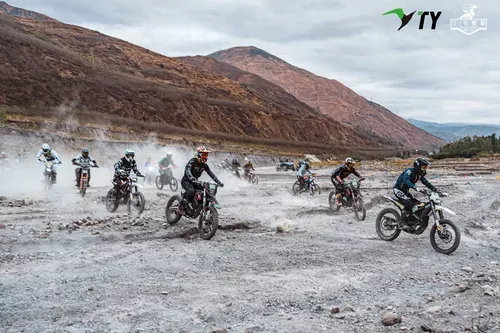
An electric off-road motorcycle can be physically capable of leaving the tarmac. That tells an operator almost nothing about where it may legally or responsibly be used.
Access depends on a chain of facts: destination, land manager, public or private route status, the legal classification of the exact vehicle, its documents, the rider, the operating model and sometimes the season or time of day. A short public-road connection can create a different question from a session that never leaves a controlled private trail.
General information, not legal advice: Rennva Off-Road eligibility depends on the destination, intended use, exact vehicle and matching regional documentation. Rules, route designations and permit conditions can change. Verify current official sources with the relevant authority, land manager and insurer before relying on any route or operating plan.
Private, public and off-road are not interchangeable
The first task is to identify the land and every route a guest, guide or staff member may use. A property marketed as a private adventure destination can still include public rights of way, shared access roads, leased parcels, protected habitat, utility corridors or routes managed by another authority. Some public-land systems designate specific roads, trails or areas for motorised recreation, subject to vehicle class and seasonal rules.
Create a route inventory rather than relying on a broad label:
- privately owned trail with written landowner permission;
- leased or concession land and the exact rights granted;
- public OHV area, forest road or designated motorised trail;
- public-road connections between trail sections;
- car parks, loading zones and service access;
- restricted, seasonal or environmentally sensitive areas;
- emergency and recovery routes.
For every segment, name the owner or authority that controls it. A resort’s approval cannot answer for land managed by someone else.
Vehicle capability is not vehicle eligibility
Operators often begin with product attributes. Regulators and land managers begin with categories and documents. Depending on location, the questions may include:
- Is the exact vehicle classified as a motorcycle, off-highway vehicle, competition vehicle or another category?
- Does it have an accepted identification and ownership document?
- Are registration, a permit, tax, insurance, a plate or particular road equipment required?
- Is the route open to that vehicle class?
- Do configuration and documents match one another?
- Are there sound, equipment, age, licence, helmet or training rules?
An answer for one model year or market should not be copied to another. Official manufacturer documents illustrate the point without answering it for Rennva. One electric motocross manual limits that model to dirt-bike tracks rather than public roads; other documents are published by precise model and market. The lesson is to read the approval material for the exact vehicle rather than generalise from “electric” or “off-road”.
The UK offers one illustration. GOV.UK’s approval guidance explains that an unapproved motorcycle may require Motorcycle Single Vehicle Approval before registration, while Highway Code Rule 158 notes that some motorcycles are suitable only for off-road use and do not meet road-use standards. These sources do not establish the status of a Rennva concept; they show that motorcycle capability and road eligibility are separate questions.
Land managers add another rule layer
Registration does not automatically open a route. In the United States, Forest Service Motor Vehicle Use Maps identify roads, trails and areas designated for motorised use, including allowed vehicle classes and seasonal restrictions. Official guidance can also warn that designation does not mean a route is maintained, passable or safe.
That creates three distinct checks:
- Vehicle status: Is the exact motorcycle correctly documented for the jurisdiction?
- Route status: Is this route open to this vehicle class on this date?
- Operating suitability: Can a guided or rental activity operate there under land-manager, permit, insurance and safety conditions?
Passing one check does not answer the other two. California’s official OHV guidance is another regional example: registration or non-resident permit conditions, riding-area status and bulletins are distinct. An international operator should maintain a dated, source-linked file for every destination instead of memorising one region’s rules.
The public-road connector problem
Many attractive trail experiences are not perfectly self-contained. Storage may sit across a road, or a route may leave private property briefly. That short connector can change the analysis. A vehicle acceptable on a private trail may not be approved, registered or insured for a public road.
If the connector cannot be resolved, redesign the operation: relocate staging, transport vehicles by an authorised method, keep the experience within one controlled parcel or select another route. Operational design can be the most effective compliance tool.
Rental and guided operations add duties
Personal recreational use and a paid guest experience are different operating models. Rental or guided programmes may introduce requirements around business licensing, concessions, insurance, waivers, staff competence, rider briefing, supervision, incident reporting, maintenance records and emergency planning.
Define minimum rider criteria, protective equipment, guide-to-guest ratio, route grading, closure triggers, familiarisation, communications, emergency access, charging, damaged-unit isolation, defect reporting and recovery. These questions belong in the operator’s documented system and must reflect approved information for the exact vehicle.
Electric changes some tasks, not the need for control
Electric motorcycles remove some combustion-related tasks while introducing charging capacity, turnaround, storage, damaged-battery handling and transport questions. A quieter powertrain does not remove tyre, drivetrain, environmental or rider-generated sound, and it may change how people detect an approaching vehicle.
Range is equally route-specific. Zero Motorcycles’ official guidance groups real-world range influences under route, rider, weather and bike factors. That is a useful general checklist, not evidence for any Rennva range figure. A responsible operator should test the exact approved configuration on representative terrain with realistic loads and conditions, then plan charging and contingency around verified results.
Rennva’s Off-Road pages present concept vehicles. No range, power, charge-time, road-status or certification promise is made in this guide.
Build a destination compliance matrix
Maintain one row for every destination and route, recording:
- country, region and local authority;
- land manager, parcel, route name and map version;
- guided, rental, training, private-guest or staff use;
- exact model, configuration, identification and model year;
- approval, registration, permit, ownership and insurance evidence;
- vehicle class, season, hours and closure conditions;
- rider, PPE, licence, training and supervision conditions;
- charging, storage, maintenance, recovery and emergency controls;
- official source, issuing body, version date, verification owner and next review trigger.
Review after a route-map revision, new vehicle configuration, regulatory bulletin, insurer change, incident or material change to the experience.
Ask a precise question
We intend to operate the exact vehicle configuration as part of a guided rental experience on named private trails in a specified destination, with no public-road segment. Which vehicle documents, land permissions, operator permits, insurance conditions and rider requirements apply?
Change the destination, route, public access, configuration or business model and the answer may change.
Rennva can review an Off-Road business enquiry once the destination, intended route and operating model are identified. Share those details through the Off-Road enquiry route. Vehicle eligibility, documentation, specification, availability and commercial terms require exact, separately approved confirmation.
Destination-check questions
Are electric off-road motorcycles automatically road legal?
No. Road eligibility depends on the destination, exact vehicle classification and configuration, approval, registration, insurance and matching regional documentation.
Does landowner permission make every private-land ride legal?
Not necessarily. Verify land rights, local rules, environmental and business conditions, insurance and every connecting route.
Can an OHV registration or permit be used everywhere?
No. Recognition varies, and land managers may restrict routes by class, season or local rule. Check the current official source.
What should an operator include in an enquiry?
Provide the country and region, exact site and route type, intended use, public-road segments, operating model and documentation requirements already identified.
Sources
Dynamic official sources were rechecked by the Rennva Editorial Team on 14 August 2026.